
Meta & Apple AI Partnership: Could Open-Weight AI Models Come Directly to Mac?
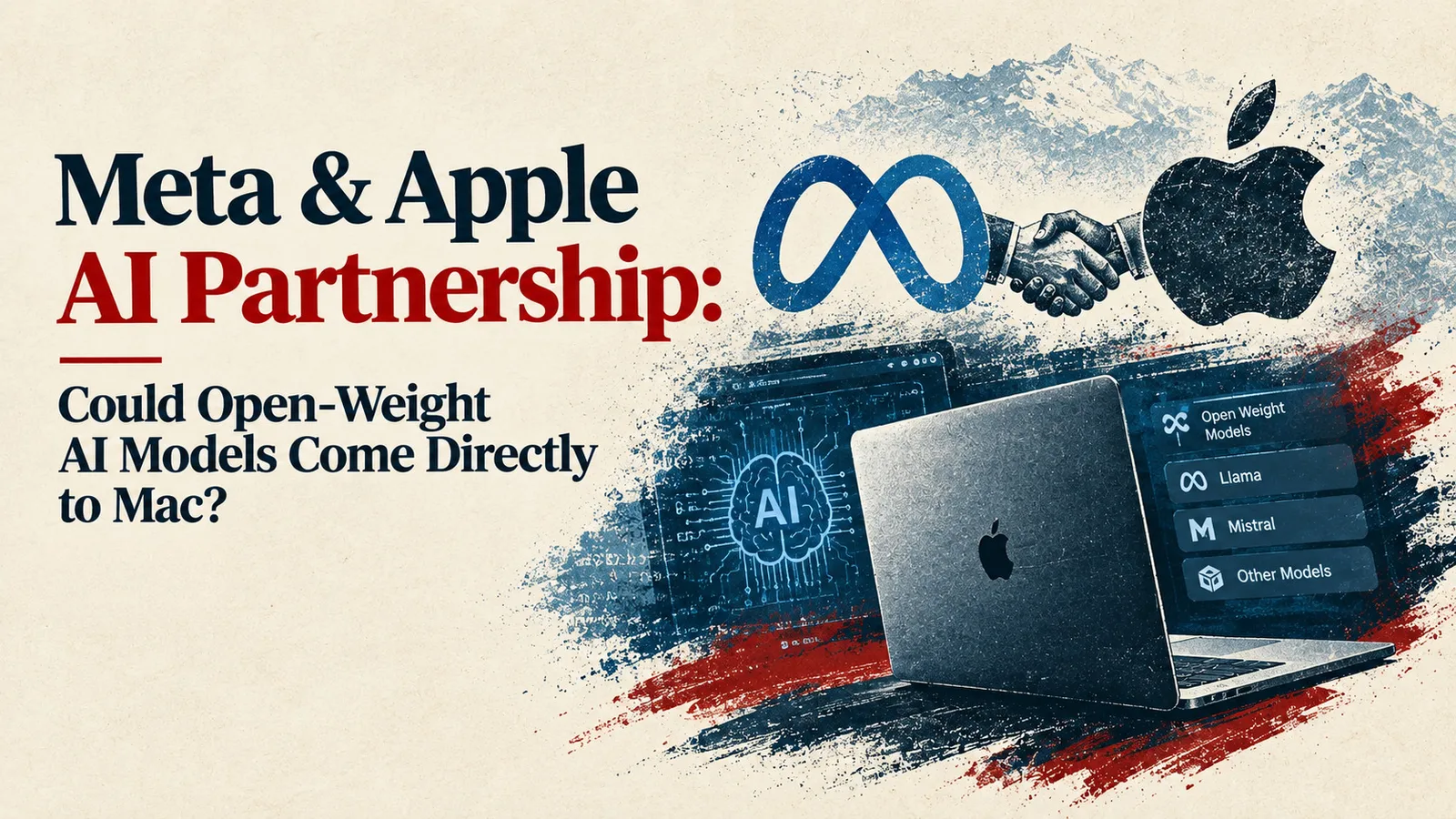
Artificial intelligence is becoming an increasingly important part of personal computing. From writing and coding to analysing documents and automating everyday tasks, AI tools are changing how people use their computers. As technology companies compete to make these tools more accessible, the possibility of Meta and Apple working together on open-weight AI models raises an important question: could Mac users gain more freedom to run AI directly on their devices?
Meta has developed its Llama family of AI models, while Apple has been expanding its own AI capabilities through Apple Intelligence and on-device machine learning. A collaboration between the two companies could bring their respective strengths together, potentially making AI tools more accessible to developers, students and everyday users.
However, the specific claim that Meta and Apple have partnered to integrate open-weight AI models directly into Mac systems requires confirmation from an official announcement or reliable reporting. Their existing AI initiatives should not be confused with a confirmed partnership.
Why Meta and Apple Could Work Together
Meta and Apple have been longtime rivals across several areas of technology, including mobile platforms, digital services, messaging and wearable devices. Despite their competition, both companies have reasons to explore new opportunities in artificial intelligence.
Meta has invested heavily in AI research and development, making its Llama model weights available under licences that allow a range of developers to use and adapt them. This has helped create an ecosystem of AI applications that can run on compatible hardware without relying entirely on proprietary cloud services.
Apple, meanwhile, has focused on integrating AI into its hardware and software ecosystem. Its approach combines on-device processing with cloud computing for tasks that require additional resources.
A potential collaboration could make compatible Meta models easier to access on Mac computers. Rather than depending exclusively on online AI services, users might have additional options for running AI applications locally.
For developers, this could create new opportunities to experiment with language models, build applications and explore AI-powered workflows within the Mac ecosystem.
What Open-Weight AI Models Mean for Mac Users
Open-weight AI models provide access to trained model parameters, allowing developers to run supported models using compatible software and hardware. However, open-weight does not necessarily mean fully open-source, as licensing conditions, training data and other components may not be publicly available.
One of the main advantages of these models is flexibility. Depending on the model and its capabilities, users can run AI tools for tasks such as summarising documents, explaining programming concepts, drafting content and organising information.
Running a model locally can also reduce dependence on an internet connection. Once the model and required software are installed, supported tasks may continue to work offline.
This could be particularly useful for students working on campus, developers travelling with their laptops or professionals who need AI assistance when connectivity is unreliable.
Local AI is not entirely new to Mac users. Several existing tools already allow compatible language models to run on Apple silicon computers. A deeper integration into macOS, if introduced, could make these capabilities easier to discover and use.
Privacy and Performance Could Become Major Advantages
Privacy is one of the strongest arguments for running AI directly on a computer.
When a task is processed entirely on the device, the information involved may not need to be sent to an external server. This can be useful when working with personal documents, private notes, source code or internal business information.
However, local processing does not automatically guarantee complete privacy. Applications may still transmit analytics or other information, so users need to understand how their software handles data.
Performance is another important consideration. Apple's silicon-based Macs combine CPU, GPU and Neural Engine capabilities, making them suitable for many machine-learning workloads. Nevertheless, the speed and reliability of local AI depend on the model's size, available memory and software optimisation.
A model that performs well on a Mac with substantial unified memory may struggle on a system with a more limited configuration.
Any future integration would therefore need to account for differences between Mac models rather than assume that every device can run every AI model efficiently.
How Developers Could Benefit
A more accessible local AI environment could offer practical benefits to software developers, students and small technology companies.
Developers could experiment with coding assistants, build AI-powered desktop applications and test model-driven features without making an API request for every interaction. For suitable workloads, local execution could also reduce recurring costs associated with cloud-based AI services.
Students learning programming could use compatible models to explore how language models work, understand unfamiliar code and experiment with AI integration.
Small businesses could investigate local AI applications for document processing, internal knowledge systems and other tasks where keeping information on company-controlled devices is desirable.
Potential applications include:
Coding assistance: Explaining functions, reviewing code and helping developers understand unfamiliar programming concepts.
Document processing: Summarising notes, extracting information and organising text.
Offline AI tools: Supporting selected workflows without a continuous internet connection.
AI application development: Building and testing applications that use locally available models.
Privacy-conscious workflows: Processing certain types of information without automatically sending every input to a cloud service.
These opportunities already exist through third-party software. A partnership could make them more accessible, but its practical value would depend on how the models were integrated, supported and maintained.
What This Could Mean for Meta and Apple
A partnership would offer potential advantages to both companies.
For Apple, supporting additional AI models could give users more choice and strengthen the Mac's appeal to developers and technology enthusiasts. It could also help expand the company's AI ecosystem beyond its own models.
For Meta, closer integration with Apple's platform could introduce its models to a wider audience. Greater accessibility could encourage more developers to experiment with Llama and create applications around Meta's AI technology.
The wider AI industry could also benefit from increased competition. More choices for running models locally could encourage improvements in model efficiency, hardware compatibility and developer tools.
However, several practical questions would need to be addressed, including licensing, software compatibility, security updates and how the models would interact with Apple's existing AI features.
Until a specific agreement is verified, these remain potential benefits rather than confirmed outcomes.
How It Could Affect Apple's Existing AI Strategy
Apple already offers AI capabilities through Apple Intelligence and its broader machine-learning ecosystem. Its approach includes on-device processing and Private Cloud Compute for certain requests that require additional computing resources.
These technologies are distinct from third-party open-weight models.
If Apple were to introduce deeper support for external AI models, users might gain additional flexibility when choosing tools for particular tasks. For example, someone could prefer a local model for straightforward text processing while using a different service for a more complex request.
Such an approach could raise important questions about model selection, compatibility, security and user control.
It would also require clear explanations of which tasks are processed locally and which may involve external servers. For users concerned about privacy, this distinction could be just as important as the capabilities of the models themselves.
The Challenges of Running AI Directly on a Mac
Despite its advantages, local AI has limitations.
Large language models can require substantial memory and processing power. Although quantisation can reduce memory requirements by representing model parameters with lower numerical precision, it may also affect output quality.
Hardware differences also matter. A model that works smoothly on a high-memory MacBook Pro may be impractical on a MacBook Air with less available memory.
Software support is another consideration. Models need compatible inference software, appropriate hardware acceleration and regular maintenance to remain useful and secure.
There are also licensing questions. Open-weight models may have specific conditions governing commercial use, redistribution or other activities. Developers must review the relevant licence rather than assume that every model can be used without restrictions.
For any future Meta–Apple integration, addressing these challenges would be essential to delivering a reliable experience.
The Bigger Shift Toward Local AI
The possibility of additional open-weight AI support on Mac computers reflects a broader change in the technology industry.
Cloud-based AI services remain valuable because they can run large models on powerful remote infrastructure. Local AI offers a different set of advantages, including reduced dependence on connectivity, potentially lower ongoing costs and greater control over where information is processed.
Neither approach is ideal for every situation. Cloud services may be better suited to some complex tasks, while smaller local models can handle many everyday requests efficiently.
As AI models become more capable and hardware improves, local processing could become a more common feature of personal computing.
Operating-system developers, chip manufacturers and AI companies will all influence how quickly this transition happens. Easier access to efficient models could also help students, independent developers and smaller businesses experiment with AI without building expensive infrastructure.
What Mac Users Should Expect Next
For now, Mac users can already explore compatible open-weight models through existing local AI applications. Anyone interested in experimenting should check model requirements, available memory, software compatibility and licensing conditions before choosing a model.
Developers should also evaluate models against their actual workloads instead of assuming that a larger model will always produce better results.
If a formal Meta–Apple partnership is announced, the most important details will be the supported models, compatible devices, privacy arrangements and whether the integration will be available to ordinary users or primarily to developers.
Those details would determine whether the collaboration represents a meaningful change in how Mac users access AI or simply another way to distribute existing models.
Conclusion
The prospect of Meta and Apple working together on open-weight AI models highlights an important direction for personal computing: bringing artificial intelligence closer to the devices people already use.
A successful integration could make local AI easier to access, create new opportunities for developers and give users more choices over how their information is processed. It could also encourage competition between AI providers and support a wider ecosystem of applications.
However, the specific partnership should not be presented as a confirmed development without reliable evidence. Meta's Llama models and Apple's AI initiatives are established parts of the industry, but their existence does not prove that the two companies have agreed to integrate Meta models directly into macOS.
Regardless of whether such a partnership materialises, the broader shift toward local AI is already underway. As models become more efficient and personal computers gain better AI capabilities, running useful AI tools directly on a laptop could become an increasingly practical option for students, developers and businesses.
Frequently Asked Questions
Have Meta and Apple officially partnered to bring open-weight AI models to Mac?
The specific partnership described in this article requires confirmation from an official announcement or reliable reporting. Meta develops Llama models, and Apple offers its own AI technologies, but those facts alone do not establish that an integration agreement exists.
What are open-weight AI models?
Open-weight AI models make their trained parameters available for users to download and run under the applicable licence. They can support local AI applications, although access to model weights does not necessarily mean the entire system is open-source.
Can Mac computers run AI models locally?
Yes. Compatible Macs can run various AI models using existing software. Performance depends on the model, available unified memory, hardware capabilities and software optimisation.
What are the benefits of local AI?
Local AI can reduce dependence on internet connectivity, provide greater control over data processing and potentially lower recurring costs for suitable workloads. However, privacy depends on the application's behaviour, and local models may have limitations compared with larger cloud-based systems.
Would Meta's AI models replace Apple Intelligence?
There is no confirmed basis to suggest that Meta's models would replace Apple Intelligence. If third-party models were integrated in the future, they could potentially complement Apple's existing technologies, depending on the design of the integration.
Why are companies interested in running AI on personal computers?
Local AI can make certain tasks faster to access, reduce dependence on remote services and support applications that process information directly on a user's device. It also gives developers another way to build and distribute AI-powered software.
Sources and Further Reading
Meta AI: Official AI research and models
Meta Llama: Official Llama model resources
Apple: Apple Intelligence
Apple Developer: Machine learning
Apple: Private Cloud Compute
Keep reading
View all →