
Nepal’s IT Skills Gap: Education vs. Industry Needs
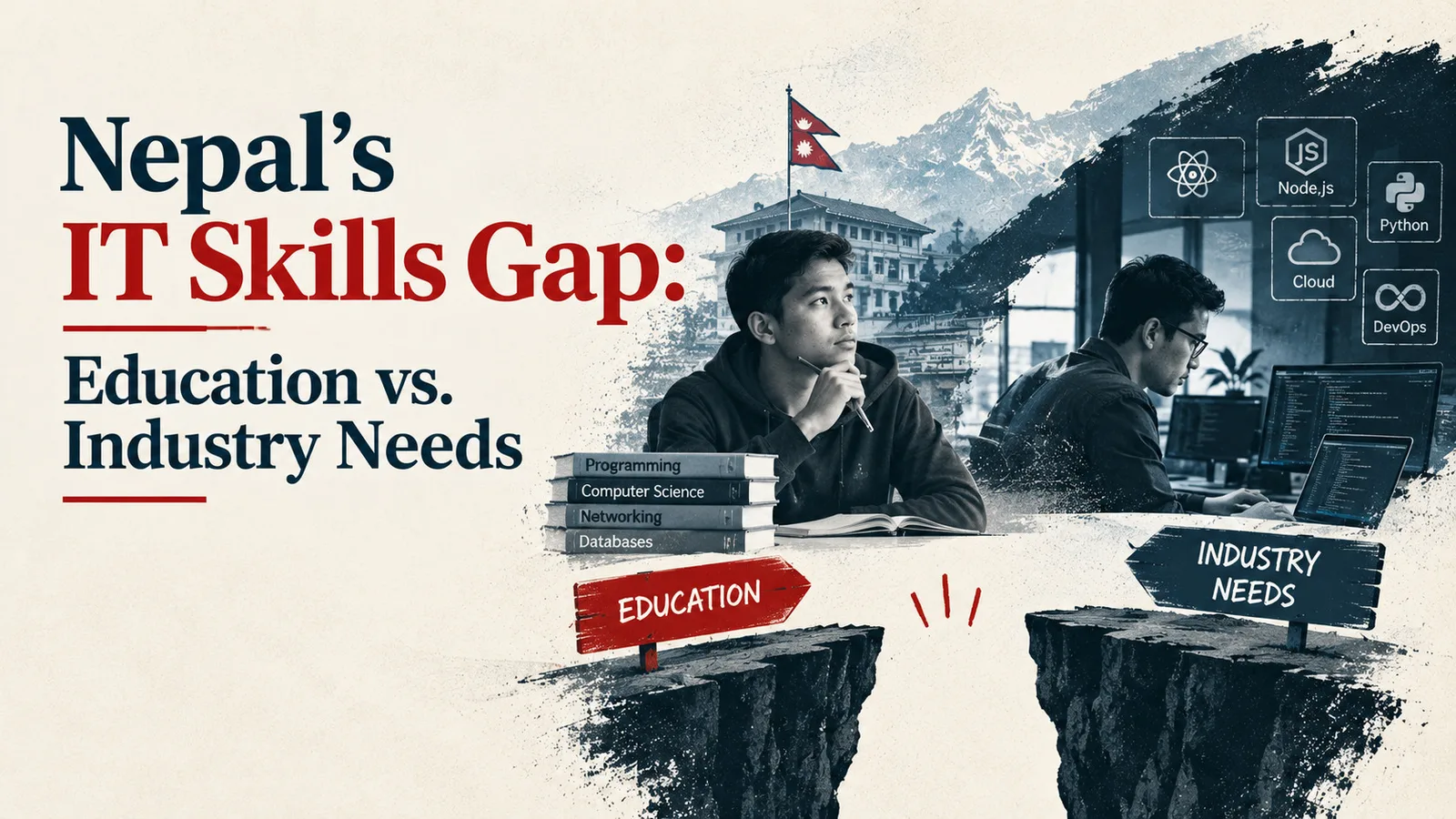
Nepal's technology industry is creating opportunities in software development, mobile applications, artificial intelligence (AI), cybersecurity and cloud computing. Yet an important question remains: are students graduating from colleges with the practical skills employers need?
A computer science degree can provide a strong foundation in programming, mathematics, algorithms, databases and computer systems. However, turning that knowledge into working software requires additional experience. Developers must understand how to build applications, work with other engineers, solve unfamiliar problems, test their code and maintain systems after deployment.
This difference between academic knowledge and workplace readiness is at the heart of Nepal's IT skills gap.
The issue does not mean that graduates lack ability or that universities have no value. Instead, it highlights a challenge facing Nepal's technology ecosystem: connecting classroom learning with the practical demands of a rapidly changing industry.
As Nepal seeks to expand its software exports and compete for international technology projects, closing this gap could become an important priority for students, universities, employers and policymakers.
What Is the IT Skills Gap?
The IT skills gap refers to the difference between the skills employers need and the skills available among job applicants.
In Nepal, the discussion often centres on graduates who understand programming concepts but have limited experience applying them to real projects. An employer may need someone who can develop a web application, connect it to a database, implement authentication, write tests, use Git and help deploy the finished product. A graduate who has primarily completed isolated classroom exercises may need additional training before taking on those responsibilities.
The same challenge appears in other areas of technology.
A mobile development team may need engineers familiar with application architecture, APIs, debugging and release processes. An AI team may need people who understand statistics, data preparation, model evaluation and the limitations of machine learning systems. A cybersecurity team may need professionals who can investigate suspicious activity, assess risks and communicate technical findings clearly.
Knowing definitions and passing examinations are useful parts of education, but they do not automatically demonstrate proficiency in these tasks.
A report published by the Industry-Integrated Degree initiative in August 2026 highlighted this mismatch between the number of IT graduates entering the workforce and their readiness for professional work. It reported an estimated 10,000 to 15,000 IT graduates annually, while noting that employers continue to identify practical skills as a concern.
Source: Industry leaders discuss Nepal’s IT skills gap — IID.
These figures should be treated as reported estimates rather than a definitive, independently audited count of every IT graduate in Nepal. Nevertheless, the wider issue deserves attention: producing graduates and preparing professionals are related, but different, goals.
Why Is the Demand for Practical IT Skills Growing?
Technology changes quickly, and the expectations placed on developers have evolved alongside it.
Businesses increasingly need software that does more than demonstrate a concept. Applications must handle real users, protect sensitive information, perform reliably and remain maintainable as requirements change.
Several areas illustrate this shift.
1. Full-Stack Development
Full-stack developers work across the front end and back end of web applications. Depending on their role, they may build interfaces, design APIs, connect databases, implement authentication and help deploy applications.
Employers do not necessarily expect every junior developer to master an entire technology stack. They do, however, benefit from candidates who understand how the components of a web application fit together.
For example, building a student management system involves much more than creating attractive pages. The developer must consider user roles, data validation, permissions, database relationships, error handling, security and performance.
A student who has completed several small projects may understand individual programming concepts but still need practice integrating them into a dependable application.
Learning a framework is a useful starting point. Understanding the underlying engineering principles is what makes those skills transferable.
2. Mobile Application Development
Mobile applications remain an important part of the digital economy. Businesses use them for payments, education, communication, shopping, logistics and internal operations.
Frameworks such as Flutter and React Native give developers ways to build applications for multiple platforms while sharing portions of their code.
However, familiarity with a framework alone does not guarantee job readiness.
Developers also need to understand application state, API integration, offline behaviour, authentication, performance, accessibility, testing and app-store release requirements. They must be able to investigate bugs that appear on particular devices or under unreliable network conditions.
In a country where users may have different devices, connectivity conditions and levels of access to technology, reliability and usability deserve particular attention.
3. Artificial Intelligence and Machine Learning
Artificial intelligence is creating new opportunities in software products, business automation, data analysis and research. It is also changing how developers approach everyday work.
But building useful AI systems requires more than knowing how to call an AI API or write prompts.
Machine learning professionals need foundations in mathematics, statistics, programming and data handling. They must understand how to prepare datasets, select suitable evaluation methods, identify unreliable outputs and determine whether a model is appropriate for a particular problem.
Developers building AI-powered applications also need to consider privacy, security, cost, latency and the possibility of incorrect results.
AI coding assistants can help students learn and work faster, but relying on generated code without understanding or testing it can create problems. The ability to verify an answer, identify a bug and explain a technical decision remains valuable.
4. Cybersecurity
As businesses, schools and public institutions rely more heavily on digital systems, protecting those systems becomes increasingly important.
Cybersecurity involves several areas, including secure software development, network security, identity and access management, vulnerability assessment, incident response and risk management.
A graduate interested in cybersecurity needs more than familiarity with security tools. Understanding operating systems, networking, programming, databases and web application architecture provides a foundation for investigating how systems fail and how they can be protected.
For example, a secure application must enforce permissions on the server rather than relying solely on what its interface displays. It should validate input, protect credentials, manage sessions appropriately and avoid exposing sensitive information through errors or logs.
These principles are relevant to developers as well as dedicated security specialists.
5. Cloud Computing and Data Engineering
Modern applications often depend on cloud infrastructure, automated deployment, monitoring and data pipelines.
Cloud engineers need to understand networking, permissions, resource management, reliability and infrastructure automation. Data engineers must be able to design pipelines that collect, transform, validate and deliver data consistently.
Students who learn only to run applications on their own computers may need additional experience before they can manage the same applications in production.
Understanding how software behaves after deployment is an important part of becoming an effective technology professional.
Why Traditional IT Education Can Struggle to Keep Up
Universities provide something essential: structured learning and a foundation in computing principles. The challenge arises when that foundation is not sufficiently connected to modern development practices and professional experience.
Several factors can contribute to the gap.
A curriculum that changes more slowly than technology
Academic programmes must cover fundamental subjects that remain useful for decades. Programming logic, data structures, algorithms, operating systems, databases and computer networks are not made irrelevant by the arrival of a new framework.
However, courses also need to help students apply these principles using contemporary tools and workflows.
When practical exercises are not regularly reviewed, students may have limited exposure to current development practices, collaborative software projects, testing, deployment and secure coding.
The solution is not to replace foundational subjects with a list of fashionable technologies. It is to connect enduring concepts with practical applications.
Too much emphasis on examinations
Examinations can assess knowledge and problem-solving ability, but they cannot measure every aspect of software engineering.
A student may perform well on a written programming question yet struggle to debug an unfamiliar codebase, interpret an error log or collaborate on a shared project.
Practical assessment can help close this gap. Students should have opportunities to design systems, write and review code, explain decisions, test their work and improve their solutions after receiving feedback.
Theory and practical work should complement each other rather than compete for attention.
Limited access to real-world projects
Classroom exercises are useful because they allow students to learn individual concepts in manageable steps. Professional software projects introduce additional challenges.
Requirements change. Bugs affect other features. Multiple developers modify the same codebase. Security decisions influence architecture. Users report unexpected behaviour, and applications must continue working after deployment.
Students can begin learning these skills through carefully designed academic projects, open-source contributions, internships and supervised work with local businesses.
The aim is not to make students responsible for production systems before they are ready. It is to introduce realistic engineering practices gradually, with appropriate guidance.
A shortage of sustained industry–academic collaboration
Universities and employers have different responsibilities, but they can learn from each other.
Employers understand the tasks their teams perform and the problems new hires commonly encounter. Academic institutions understand how to structure learning, assess progress and teach foundational concepts.
When these groups collaborate, they can identify missing competencies, improve project work and create more meaningful internship opportunities.
Without regular communication, however, a curriculum may struggle to reflect changes in the workplace.
Unequal access to learning resources
Students do not all have the same access to reliable internet, suitable computers, experienced mentors or professional networks.
Some can participate in internships, attend workshops and collaborate with experienced developers. Others may have to learn largely on their own.
This difference can influence how much practical experience students gain before graduation.
Addressing the skills gap therefore requires more than telling students to work harder. It also means making quality learning resources, mentorship and practical opportunities more accessible.
Nepal Is Beginning to Explore Industry-Integrated IT Education
The skills gap is not just a subject for debate. Nepal's IT sector has begun exploring ways to connect formal education with workplace experience more directly.
One example is the Industry-Integrated Degree (IID) initiative developed through collaboration between the Nepal Association for Software and IT Services Companies (NAS-IT) and Nepal Open University, with support from the Swiss Agency for Development and Cooperation and technical assistance from Swisscontact.
According to the initiative's published materials, its model combines academic study with practical experience in partner companies. Its curriculum development has involved industry professionals and academic experts.
In August 2026, the initiative identified five specialization areas:
Application development
Artificial intelligence
Cloud engineering
Data engineering
Cybersecurity
The programme's stated objective is to help students build foundational knowledge while gaining exposure to real workplace expectations.
Sources: IID curriculum development and industry collaboration and Five IT specializations announced by IID.
This approach is worth watching because it attempts to address the relationship between education and employment through curriculum design and practical experience together.
Its long-term effectiveness will depend on implementation, the quality of mentorship, access to participating companies and evidence of how well graduates perform after completing the programme. One initiative alone cannot resolve every challenge facing Nepal's IT education system, but it provides an example of how industry and academia can work together.
What Can Students Do to Become More Job-Ready?
Students do not have to wait for an entire university curriculum to change before developing practical skills. They can supplement their studies with a focused learning process.
The goal should not be to learn every popular programming language or framework. It should be to build a solid foundation, apply it to meaningful problems and demonstrate the ability to learn independently.
Build strong fundamentals first
Programming, data structures, algorithms, databases, operating systems, networking and software engineering principles provide a foundation for many technology careers.
These subjects may seem less exciting than the newest AI framework, but they help developers understand why systems behave as they do.
A student with strong fundamentals can generally adapt more easily when tools, languages and frameworks change.
Choose a direction and practice consistently
Once the fundamentals are developing, students can explore a particular area.
An aspiring full-stack developer might focus on web interfaces, APIs, databases, authentication and deployment. Someone interested in mobile development might build an application that works with a real backend. An AI enthusiast might explore data preparation, model evaluation and a small machine learning project. A cybersecurity learner might study networking, Linux and secure application design using legal practice environments.
Exploration is useful, but attempting to master several specializations simultaneously can leave students with shallow knowledge of each.
It is often better to build one complete project before moving to the next.
Build projects that solve real problems
A portfolio is most useful when it demonstrates how a student thinks and works, not simply how many projects they can list.
A useful project should have a clear purpose, a working implementation and an explanation of the decisions behind it.
For example, a student could build a school notice and attendance application, a small inventory management system or a mobile application that helps users organize their daily tasks.
A strong project might include:
A clearly defined problem and intended users
A sensible database design
Input validation and appropriate access controls
Automated tests for important behaviour
Version control using Git
Documentation explaining setup and design decisions
A deployed demonstration, where practical
The project does not need to be enormous. A smaller application that works reliably and can be explained in depth may demonstrate more than a large project assembled without understanding its code.
Learn to work with other developers
Professional software development involves communication as well as programming.
Students should practice using Git branches, reviewing code, documenting decisions, reporting bugs and discussing technical trade-offs.
Group projects can help develop these skills when team members share responsibilities and understand the code they submit.
Use AI tools as learning assistants
AI coding tools can explain unfamiliar concepts, suggest debugging approaches and help students explore alternatives. Used thoughtfully, they can support learning.
A useful workflow is to understand the problem, attempt a solution, ask for targeted assistance, verify the explanation, test the code and explain the final implementation in one's own words.
Blindly accepting generated code can hide mistakes and make it difficult to maintain a project later.
The objective should be to become a capable developer who can use AI effectively, rather than someone who can produce code only when an AI tool supplies it.
Seek feedback and practical experience
Internships, supervised freelance work, open-source contributions, hackathons and mentorship can expose students to problems that are difficult to reproduce in isolated exercises.
Students should choose opportunities appropriate to their current skill level and avoid treating unpaid work or certificates as automatic guarantees of employment.
The most useful experiences provide feedback, encourage problem-solving and help students understand how professional teams operate.
What Should Universities and Colleges Change?
Students can take responsibility for their own learning, but educational institutions have an equally important role.
Review curricula with industry input
Colleges should periodically consult developers, engineering managers, security professionals, researchers and technology companies to identify changing skill requirements.
Industry feedback should inform practical exercises and specialization choices while preserving the fundamentals that make a degree valuable.
Make project work central to assessment
Students should have repeated opportunities to develop software throughout their degrees rather than encountering their first substantial project near graduation.
Projects can progress from small programming assignments to database-backed applications, team software and final-year systems with realistic requirements.
Assessment should consider correctness, maintainability, testing, documentation, security and the student's ability to explain their decisions.
Expand internships and mentorship
Colleges can develop partnerships with local IT companies, startups and technology organizations.
Even relatively small collaborations can provide benefits: industry professionals can review student projects, explain common workplace challenges or mentor teams working on practical problems.
Internships should have clear learning objectives and appropriate supervision rather than relying on students to figure everything out without support.
Invest in teaching and practical infrastructure
Faculty members need opportunities to update their technical knowledge and connect academic concepts with current engineering practices.
Institutions should also provide adequate laboratory access, software development environments, collaborative tools and reliable learning resources.
Practical education is more effective when students can regularly experiment, make mistakes and learn from them.
What Should IT Companies Do?
Employers also influence the skills gap through their hiring and training practices.
Companies can communicate the competencies expected of entry-level developers, offer internships with meaningful responsibilities and provide structured mentoring for new employees.
Hiring processes should distinguish between essential skills and tools that can be learned after joining. A candidate with strong fundamentals, sound reasoning and a willingness to learn may have greater long-term potential than someone who has memorized many technologies but cannot explain their work.
Companies can also contribute to academic projects, share anonymized examples of common engineering problems and help educators understand how professional practices evolve.
No graduate should be expected to know every tool used by an experienced engineer. Entry-level hiring should account for the fact that professional competence develops over time.
Will Artificial Intelligence Make the IT Skills Gap Worse?
AI introduces both opportunities and challenges for technology education.
AI assistants can make programming help more accessible, accelerate routine tasks and allow students to experiment with ideas that might previously have required more time or experience.
At the same time, generated code can create an illusion of competence. An application may appear to work while containing security weaknesses, poor architecture or errors that become visible only under unusual conditions.
As AI tools become more capable, the value of understanding the output may increase rather than disappear.
Developers need to evaluate generated code, check assumptions, test edge cases and determine whether a proposed solution actually meets its requirements. AI specialists need to understand data quality and model evaluation. Cybersecurity professionals need to recognize how AI changes both defensive practices and potential threats.
The most useful preparation is therefore not simply learning to operate the latest AI tool. It is developing the technical judgment needed to use such tools responsibly and effectively.
Why Closing the Skills Gap Matters for Nepal's Economy
Nepal's IT industry has opportunities to serve domestic businesses and international clients. However, sustainable growth requires more than internet access and competitive operating costs.
Companies need people who can deliver reliable software, communicate with clients, protect information and maintain products over time.
A stronger connection between education and industry could help businesses spend less time addressing basic skill deficiencies and more time developing new products and services. It could also help graduates demonstrate their abilities, find appropriate opportunities and progress into specialized roles.
For Nepal, the benefits may extend beyond individual employment. A larger pool of capable technology professionals could support startups, digital services, research, entrepreneurship and the development of locally relevant software.
These outcomes are not automatic. They depend on the quality of education, business investment, access to opportunities and the ability of companies to compete in international markets. But improving practical skills is an important part of creating the conditions for that growth.
The Road Ahead: From Degrees to Demonstrable Skills
Nepal does not need to choose between academic education and practical training. It needs both.
A university degree can teach students to reason about algorithms, systems and the principles behind computing. Practical experience can help them apply those ideas to real problems, collaborate with others and develop the judgment required in professional work.
The strongest approach combines the two.
Students should graduate with more than a certificate: they should have a foundation in computer science, experience building and testing software, an understanding of professional workflows and the ability to keep learning as technology changes.
Universities should connect theory with application. Employers should contribute to training and mentorship. Policymakers and industry associations should encourage collaboration and evaluate whether new approaches produce better outcomes.
Nepal's IT skills gap is a challenge, but it is also an opportunity to improve how the country prepares its next generation of technology professionals.
If education and industry work more closely together, Nepal can build a workforce better equipped to develop software, strengthen digital security and participate in the global technology economy.
Frequently Asked Questions
What is the IT skills gap in Nepal?
The IT skills gap is the difference between the competencies employers require and those job applicants possess. In Nepal, the discussion often concerns practical software development, problem-solving, modern engineering workflows and experience working on real projects.
Which IT skills are useful for students in Nepal?
Programming fundamentals, data structures and algorithms, databases, networking, operating systems, Git, testing, communication and problem-solving are useful across many roles. Students can then specialize in areas such as full-stack development, mobile applications, AI, cloud computing, data engineering or cybersecurity.
Why do some IT graduates need additional training?
A degree may provide a strong theoretical foundation without providing enough experience with integrated projects, collaborative development, debugging, testing and deployment. Additional practical experience can help graduates apply their knowledge in professional settings.
Can students become job-ready without a computer science degree?
Some people enter technology careers through self-study, vocational programmes or alternative educational routes. A degree can still provide valuable structure and foundational knowledge. Regardless of the route, demonstrable skills, practical projects and the ability to solve problems are important.
Will AI replace software developers?
AI is changing software development by assisting with coding, testing and other tasks. Its longer-term effects will vary by role and industry. Understanding software systems, validating solutions, making engineering decisions and communicating with stakeholders remain important capabilities.
What is Nepal doing to address the IT skills gap?
One example is the Industry-Integrated Degree initiative developed through NAS-IT and Nepal Open University with support from SDC and Swisscontact. Its stated approach combines academic learning with industry experience and includes specializations in application development, AI, cloud engineering, data engineering and cybersecurity.