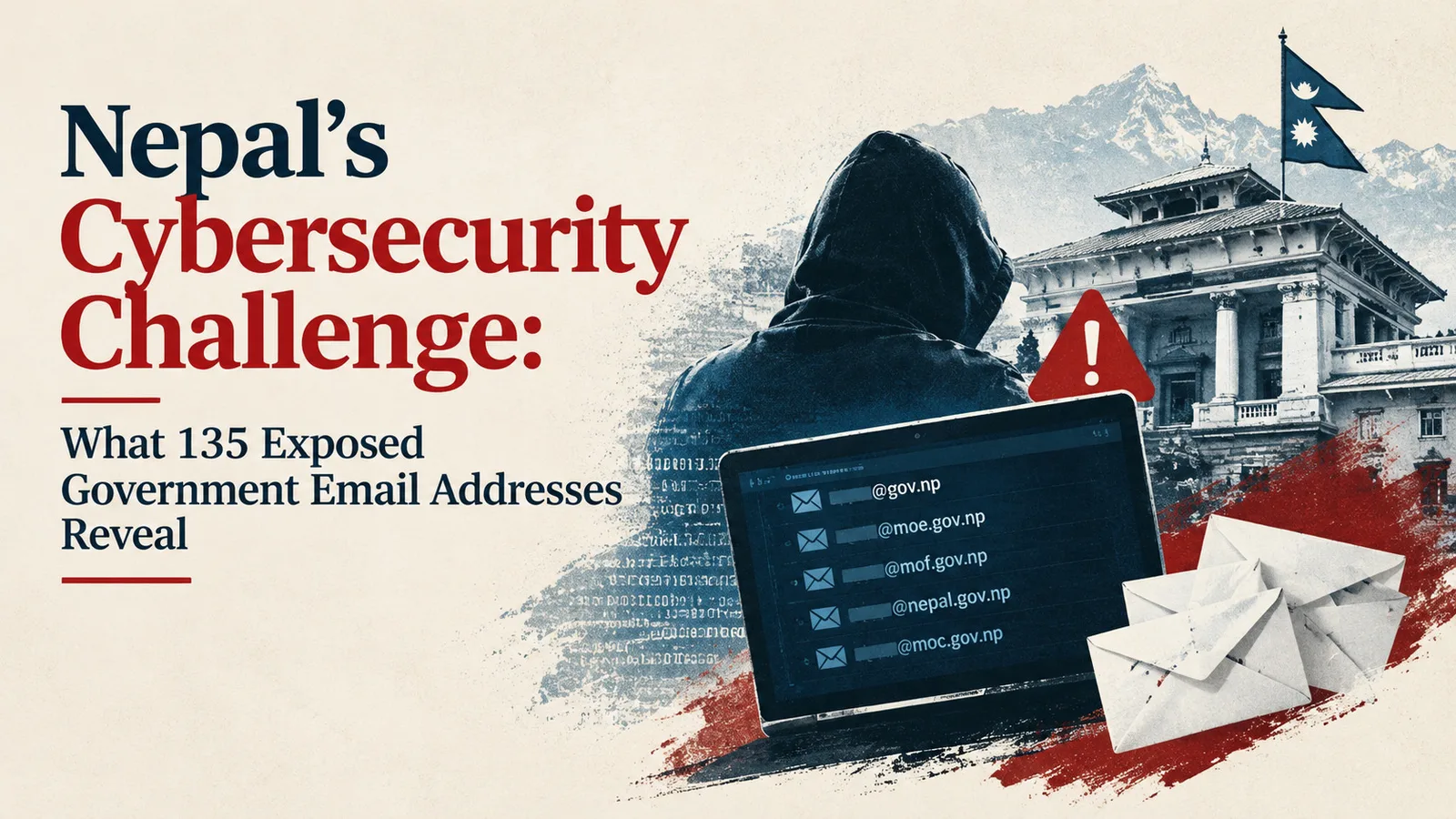
Nepal’s Cybersecurity Challenge: What 135 Exposed Government Email Addresses Reveal
Nepal’s digital transformation has made government services, public records and official communication increasingly dependent on technology. But as more public services move online, protecting the systems behind them has become just as important as building them.
A cybersecurity finding reported in August 2026 brought this issue into focus. At least 135 official email addresses under Nepal’s primary nepal.gov.np domain were found in previously reported data breaches after Nepal joined an international email breach-monitoring service, according to The Kathmandu Post.
The affected addresses included those associated with officials working at the Office of the Prime Minister and Council of Ministers, the Ministry of Home Affairs, the Ministry of Finance and the Ministry of Foreign Affairs.
The discovery raised concerns about the security of official communications and the possibility that exposed credentials could be misused. It also highlighted a broader challenge for Nepal: strengthening cybersecurity as government institutions become more dependent on digital infrastructure.
However, there is an important distinction. An email address appearing in breach data does not, by itself, prove that the government’s email servers were directly hacked or that government databases were accessed. The actual risk depends on what information was exposed, whether passwords were included and whether those credentials were reused elsewhere.
What Happened to Nepal’s Government Email Accounts?
According to The Kathmandu Post, Nepal joined Have I Been Pwned, an international service that collects information about publicly reported data breaches and helps users and organizations identify exposed email addresses.
Following the integration, Nepal’s National Cyber Security Centre conducted an initial check of government email addresses. The preliminary findings identified 135 addresses under the nepal.gov.np domain in breach data.
The report, published on August 6, 2026, said officials were being notified and steps were being taken to secure affected accounts.
The development gave government authorities a clearer way to identify email addresses associated with known data breaches and respond to potential risks.
It is important to understand what the finding does and does not establish. The appearance of an address in a breach-monitoring database may mean that it was exposed through a third-party service, website or another incident. It does not automatically establish that the official government email system itself was compromised.
If a leaked password was also exposed and reused for a government account, however, the risk could be considerably more serious.
Why Government Email Security Matters
Official email is more than a communication tool. It can be part of the process through which government employees exchange documents, coordinate services, approve work and communicate with other institutions.
If an attacker gains unauthorized access to an official account, the consequences may extend beyond the account holder.
Depending on the account's access and the information available, an attacker could potentially read confidential correspondence, impersonate an official, send fraudulent instructions or use the account to target other employees.
Even when an email address is exposed without its password, it can still be useful to criminals. A known official address can help them create more convincing phishing messages or impersonate someone working in a government office.
These possibilities do not mean that every exposed address has been misused. They explain why organizations should investigate breach notifications and take proportionate security measures rather than ignoring them.
For government institutions, protecting email accounts is part of protecting the integrity of official communication.
How Data Breaches Can Put Government Accounts at Risk
An email address may appear in breach data for several reasons. For example, an employee might use an official email address to register for an unrelated online service. If that service later suffers a data breach, the address could appear in the exposed information.
The consequences depend on the data involved.
Exposed email addresses
An exposed email address can increase the amount of unwanted communication an employee receives. It can also make targeted phishing attempts easier because attackers already know a legitimate address and may infer the person's workplace or role.
An exposed address alone does not establish that an account has been accessed.
Exposed passwords
The risk increases if a breach includes a password that is still in use. If the same password protects multiple accounts, a criminal who obtains it from one service may try to use it elsewhere.
This is one reason organizations encourage unique passwords and the use of multifactor authentication.
Exposed personal or confidential information
Some breaches contain additional personal information. Depending on the incident, this may create risks involving identity misuse, targeted scams or unauthorized disclosure.
The specific information exposed in the 135-address finding should not be assumed without evidence. Authorities need to assess the underlying breach records and determine whether passwords or other sensitive details were involved.
Phishing Is Another Major Cybersecurity Concern
Phishing is a technique in which criminals impersonate a trusted person or organization to persuade someone to reveal information, open a malicious attachment or take an unsafe action.
Government employees and members of the public may receive messages that appear to come from official institutions, senior officials or law enforcement agencies.
Such messages may use urgent language, legal threats or claims of an immediate problem to pressure recipients into responding without checking whether the message is genuine.
In its August 2026 reporting, The Kathmandu Post also described fraudulent emails impersonating senior officials and government offices.
The use of artificial intelligence can make these messages more convincing by helping criminals produce polished language and adapt messages to their intended recipients. However, phishing does not depend on AI; it has long been a common method of online fraud.
Recognizing suspicious communication is therefore an important part of cybersecurity, alongside technical protections.
Employees should verify unusual requests through a separate, trusted communication channel, particularly when a message asks for credentials, sensitive documents or urgent action.
Members of the public should also be cautious about messages claiming to come from government agencies, especially if they demand immediate payment or personal information.
Nepal’s Government Cybersecurity Efforts
The discovery of exposed email addresses is one part of a broader effort to strengthen Nepal's digital security.
According to The Kathmandu Post, the National Cyber Security Centre has been using monitoring and security tools to help identify threats and investigate suspicious activity. The report also said the centre had increased vulnerability assessment and penetration-testing activities across government systems.
These measures can help institutions identify weaknesses before they are exploited and improve their ability to detect and respond to security incidents.
Security monitoring, however, is only one part of the solution. Organizations also need clear procedures for responding to alerts, managing credentials, updating software and coordinating investigations.
A breach notification is most useful when it leads to a timely assessment and appropriate action.
Government agencies must also ensure that employees understand how to report suspicious messages, protect their accounts and handle sensitive information. Technology and human awareness work best when they support each other.
The Risk of Outdated Software and Weak Digital Infrastructure
Cybersecurity depends on the condition of the entire system, not simply the strength of a password.
Government websites and applications may rely on operating systems, software frameworks, databases and third-party components that need regular maintenance. When security updates are delayed or unsupported software remains in use, known vulnerabilities may remain available to attackers.
Poorly configured access permissions, inadequate logging and weak account-management procedures can create additional risks.
The challenge can become more complicated when institutions use new technologies without sufficient security review. AI-assisted development, for example, can help teams build applications more quickly, but generated code still needs to be reviewed, tested and configured correctly.
An application that looks finished is not necessarily secure.
Public-sector organizations should include security considerations from the beginning of development rather than treating them as a final check before a system goes live.
Practical Steps to Strengthen Government Cybersecurity
Addressing cybersecurity risks requires coordinated action from institutions, technical teams and individual employees.
1. Secure affected accounts promptly
When an address appears in breach data, security teams should establish what information was exposed and whether the account remains at risk.
If credentials may have been compromised, they should be changed through the organization's official process. Reused passwords should also be replaced on other accounts, and suspicious account activity should be investigated.
Responses should be based on the evidence available rather than assuming every breach notification represents the same level of risk.
2. Enable multifactor authentication
Multifactor authentication adds a second verification step beyond a password. This can help protect an account even if its password has been exposed.
Government institutions should prioritize strong authentication for email accounts, administrative systems and other services that provide access to sensitive information.
3. Improve password practices
Employees should use unique passwords for different services and avoid reusing workplace credentials on unrelated websites.
Organizations can support this practice through approved password managers, clear account policies and secure procedures for recovering access.
4. Keep software updated
Operating systems, applications, server software and third-party components should receive security updates according to a defined maintenance process.
Unsupported systems should be identified and upgraded, replaced or isolated where appropriate. Regular security assessments can help organizations prioritize the most significant risks.
5. Monitor suspicious activity
Security teams need ways to identify unusual sign-ins, unexpected account changes and suspicious messages or data transfers.
Monitoring should be paired with a clear response process so that alerts can be investigated and appropriate action taken quickly.
6. Train employees to recognize phishing
Employees should learn to identify suspicious links, unexpected attachments, requests for credentials and messages that create artificial urgency.
Training should be practical and ongoing. Staff should also know how to report a suspected incident without fear of being blamed for raising a concern.
7. Prepare an incident response plan
Organizations should establish who is responsible for investigating an incident, disabling compromised access, notifying affected parties and restoring normal operations.
Regular exercises can help teams test these procedures before a serious incident occurs.
What Citizens and Businesses Can Learn From This Finding
The reported exposure of government email addresses also offers lessons for individuals, schools, businesses and other organizations.
An email address connected to a workplace should not automatically be treated as safe simply because it belongs to a trusted domain. Account security depends on how credentials are protected, how access is managed and how suspicious activity is handled.
Organizations of every size can take several practical steps:
Use unique passwords for important accounts.
Enable multifactor authentication wherever available.
Keep devices and software updated.
Limit access to information according to each person's responsibilities.
Back up important data and periodically test recovery procedures.
Verify unusual requests before sharing information or approving transactions.
Establish a clear way to report suspected security incidents.
Individuals can also check whether their email addresses appear in known breaches using a reputable breach-notification service. Such a check should be performed through the service's official website, and users should never provide their password to a website claiming to check whether it has been leaked.
Finding an address in breach data is a reason to assess security, not proof that every associated account has been taken over.
Cybersecurity Is Essential to Nepal’s Digital Future
Nepal's digital services can create significant benefits for citizens, businesses and public institutions. Online systems can make information easier to access, reduce administrative burdens and support more efficient public services.
But these benefits depend on trust.
Citizens need confidence that government systems will handle their information responsibly. Public employees need secure tools for communicating and managing official work. Institutions need the ability to detect problems, respond effectively and restore services when something goes wrong.
The finding involving 135 government email addresses illustrates why cybersecurity cannot be treated as a one-time technical task. It requires ongoing monitoring, sound software maintenance, secure account practices, trained personnel and clear institutional responsibility.
The next step is not simply to count exposed addresses. It is to understand what was exposed, reduce the risk to affected accounts and use the findings to strengthen security across public-sector systems.
As Nepal continues to expand its digital infrastructure, cybersecurity must develop alongside it. A digital government is only as trustworthy as the systems and practices protecting the information entrusted to it.
Frequently Asked Questions
Were Nepal’s government email servers hacked?
The reported finding established that 135 official email addresses appeared in previously reported breach data. That fact alone does not prove that Nepal's government email servers were directly hacked. Determining whether accounts or government systems were accessed requires further investigation.
What does it mean when a government email address appears in breach data?
It means that the address was found in information associated with a known data breach. The exposed information may vary from one incident to another. An email address alone does not establish that a password or government record was stolen.
What is Have I Been Pwned?
Have I Been Pwned is a service that collects information about publicly reported data breaches and helps people and organizations check whether email addresses appear in known breach data. Its findings can support security checks, but they do not replace an investigation into a specific incident.
How can government email accounts be protected?
Organizations can use multifactor authentication, unique passwords, timely software updates, account monitoring, restricted access permissions and employee security training. They should also have clear procedures for responding to suspected compromise.
Why is phishing a concern for Nepal?
Phishing messages can impersonate trusted organizations or officials to pressure people into revealing information or taking unsafe actions. Awareness, verification through trusted channels and technical email protections can help reduce this risk.
Can AI increase cybersecurity risks?
AI can help legitimate security teams identify patterns and improve workflows, but it can also help criminals produce convincing fraudulent messages or accelerate certain malicious activities. Organizations need appropriate technical controls, staff training and human review to manage these risks.
Sources and Further Reading
The Kathmandu Post: Nepal uncovers 135 compromised government email accounts after joining global breach tracker
Kantipur: Government emails at risk of theft, 135 IDs ‘breached’
Have I Been Pwned: Official website